
Extreme Heat Is Disrupting the Global Apparel Supply Chain — How Should Dyeing Mills Build Climate Resilience into Raw Material Sourcing?
QYJSSA/August 21,2026
Highlights
| 01 | In summer 2026, all 50 of the world's hottest cities were located in India; research from NYU Stern shows heat-driven absenteeism cuts Indian garment manufacturers' productivity by up to 10% in peak summer |
| 02 | Extreme heat and humidity threaten not only workers' health but also damage equipment and compromise fabric handling — the impact is transmitting along the "garment manufacturing → dyeing & printing → upstream raw materials" chain |
| 03 | For dyeing mills, sourcing criteria for key auxiliaries such as sodium sulphate are shifting from "price first" to "resilience first": verified capacity, multi-region warehousing, and multimodal logistics are becoming hard requirements |
Over the past two years, extreme heat has kept breaking records worldwide, and Asia's supply chains — serving a US$1.7 trillion global fashion industry — are on the front line. Epic Group, which produces garments for UNIQLO, has even built an entirely new climate-resilient industrial park in response. This article answers one question: as extreme weather becomes the norm, how does heat stress travel down the supply chain to dyeing and printing, and what criteria should dyeing mills use when selecting suppliers of key auxiliaries such as sodium sulphate (Na2SO4) to keep climate risk outside their factory gates?
Extreme Heat Is Directly Cutting Apparel Production Capacity
The garment industry's production model makes it especially vulnerable: large numbers of workers crowded into confined spaces, heat-generating sewing and ironing equipment, and factory buildings that are often rudimentary and poorly ventilated. In 2026, the data pushed the issue to the forefront.
Research by air-quality monitoring platform AQI.in on global temperatures in April and May 2026 found that all 50 of the world's hottest cities were located in India. A June 2026 study by the NYU Stern Center for Business and Human Rights shows that extreme heat drives up worker absenteeism in India, costing garment manufacturers up to 10% of productivity during peak summer months.
This is not a short-term fluctuation. A November 2025 report from Cornell University's Global Labor Institute and the International Finance Corporation (IFC) notes that the global garment industry directly employs more than 90 million people — roughly half of them in India — and that about three-quarters of 23 major production centers analyzed have seen the average number of days above 35°C increase by 10% or more over the past two decades. A February 2026 study by HeatWatch and the Tata Institute of Social Sciences found that in India alone, 87% of garment workers suffered a heat-related illness in the past 12 months.
Once heat makes factory attendance and production scheduling unstable, the volatility travels upstream along the order chain.
How the Impact Reaches Dyeing and Raw Material Sourcing
The first stop is dyeing and printing. Describing the impact of extreme heat, Epic Group's general manager noted that extreme heat and humidity also damage equipment and disrupt garment assembly — "we need to treat fabric as carefully as food." Dyeing happens to be one of the most temperature- and humidity-sensitive links in the supply chain: in reactive dyeing, sodium sulphate acts as an exhausting agent directly involved in dye uptake. When heat and humidity narrow the process window, the purity and batch-to-batch consistency of auxiliaries have an amplified impact on dyeing quality — the same dyestuff paired with a batch of sodium sulphate whose impurity level fluctuates can produce visible deviations in shade and levelness.
The second stop is procurement compliance. In April 2026, the American Apparel and Footwear Association (AAFA) — whose 1,100+ members include Ralph Lauren and Levi Strauss — issued new guidance on heat stress, urging brands and suppliers to share responsibility. The IFC's US$100 million debt facility to Epic Group also comes with strict targets for cutting greenhouse gas emissions and freshwater consumption. Climate responsibility on the brand side is extending upstream to raw material suppliers — when dyeing mills screen sodium sulphate suppliers, ESG credentials are shifting from "nice to have" to "condition of entry."
For procurement teams, the conclusion is straightforward: extreme weather is no longer an occasional variable — it is a standing parameter in the supply model. The diagram below shows how heat stress transmits along the supply chain to sodium sulphate sourcing decisions:
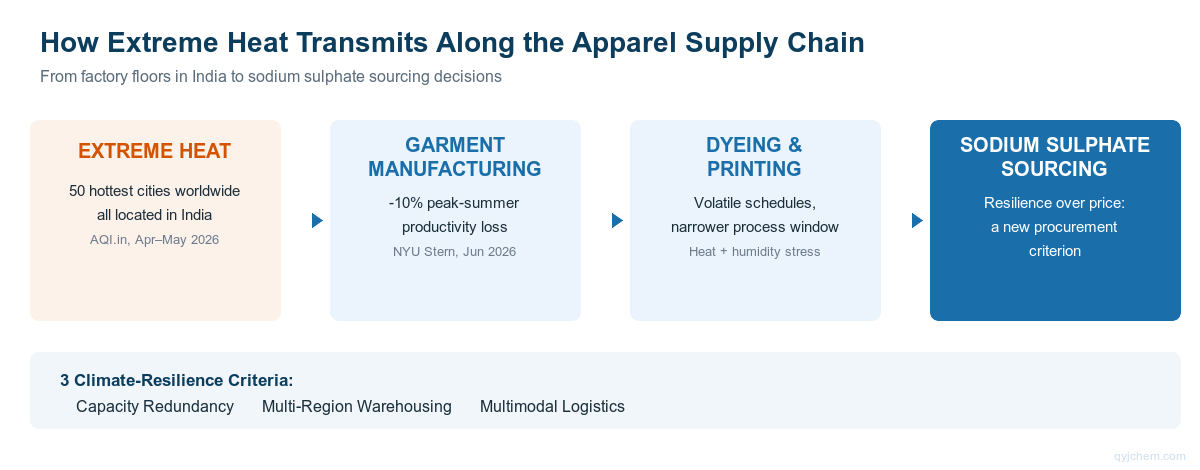
Figure 1: How extreme heat transmits from garment manufacturing to raw material sourcing, with three climate-resilience criteria. Source: QYJSSA
Three Climate-Resilience Criteria for Auxiliary Suppliers
Criterion 1: Capacity headroom and a resource base. Demand swings in hot seasons require suppliers with both production flexibility and reserves that are not hostage to a single production cycle. Take Sichuan Hongya Qingyi River Sodium Sulphate Co., Ltd. (QYJSSA): annual capacity at the one-million-tonne scale with an effective monthly supply of 65,000 tonnes; its Baita mine holds 25 billion tonnes of proven reserves — 400 years of mineable life — with ore grading about 40% Na2SO4. Mineral sodium sulphate from a captive mine does not depend on the output of any other industrial host product, so its supply rhythm is insulated from volatility in the lithium or coal-chemical industries that generate by-product sodium sulphate.
Criterion 2: Multi-region warehousing. Weather-driven logistics disruptions are usually regional; the closer the warehouse network sits to the production cluster, the more controllable the supply risk. Qingyi River operates domestic warehouses in Leshan/Yibin (Sichuan), Chongqing, Zhenjiang/Nanjing (Jiangsu), and Qinzhou (Guangxi), and overseas warehousing across Southeast Asia, South Asia, the Middle East, Africa, and South America — overlapping almost exactly with the world's garment-dyeing clusters. When local logistics are disrupted, cargo can be rerouted from the nearest stock.
Criterion 3: Multimodal logistics and flexible terms. A single transport mode is at its most fragile in extreme weather. Leveraging the Yangtze River waterway, the China–Europe Railway Express, and the New International Land-Sea Trade Corridor, Qingyi River organizes road, rail, and river-sea intermodal transport, in bulk or containerized ocean freight, under FOB/CIF/DAP terms, shipping from any Chinese seaport.
On compliance, Qingyi River was among the first Chinese sodium sulphate suppliers certified under the CORE Responsible Mining standard in 2016 (certified by Control Union, 500,000 tonnes of certified annual output), covering six dimensions including labor rights, occupational health, and the environment; since 2020 its MVR process has achieved zero carbon emissions in production. When brand-side climate audits travel upstream, these credentials can be written directly into a dyeing mill's supply-chain ESG report.
Conclusion
The impact of extreme heat on the apparel supply chain ultimately turns into stricter procurement checklists. For dyeing mills, reassessing the supply arrangement of key auxiliaries such as sodium sulphate against the three criteria of capacity, warehousing, and logistics costs far less than a supply cut in the middle of a hot season.
To evaluate a sodium sulphate supply solution that fits your sourcing model, or to request free samples and third-party quality inspection reports, feel free to submit an inquiry.
Submit an Inquiry →