
The Most Expensive Clause in a Chemical Export Contract: How to Write Test Methods and Acceptance Standards
QYJSSA/October 27,2026
Highlights
| 01 | In a China-Germany fertilizer trade arbitration, the Chinese exporter passed the domestic inspection before shipment, but the German buyer rejected the cargo using a different test method customary in the European market. Because the contract specified neither the test method nor the acceptance standard, the tribunal ruled on international standards — and the Chinese side lost (Businessweek Chinese ed., Issue 602) |
| 02 | In sodium sulphate (anhydrous Na2SO4) export contracts, purity, chloride content, whiteness and particle size must each be tied to a named test method and acceptance standard. Trade custom and verbal practice are not recognized in arbitration |
| 03 | Confirming a reference sample and arranging third-party inspection before signing moves the definition of "conformity" ahead of any dispute — the cheapest form of quality risk control |
In chemical exports, buyer and seller often disagree on what "conforming goods" actually means — and the gap is rarely in the product itself. It lies in which test method is used and which acceptance standard applies. This article uses a real China-Germany fertilizer arbitration case to explain why the test-method clause matters, what a sodium sulphate purchase contract should pin down, and how exporters can lock the quality definition before signing through samples and third-party inspection.
The China-Germany Fertilizer Arbitration: Tested and Passed, Yet Lost the Case
As reported in Businessweek Chinese edition (Issue 602), Li Tingwei, senior supervisor of the research department at the Shanghai International Arbitration Center (SHIAC), analyzed a typical case. A Chinese company exported fertilizer to Germany. Before shipment, the cargo was tested under Chinese domestic inspection norms, using pure water as the solvent, and obtained a certificate of conformity. On arrival in Germany, however, the buyer tested the cargo using the saline method customary in the European market and claimed the goods failed the specification. The two sides disagreed fundamentally on the definition of "conformity" — and the contract had specified neither the test method nor the acceptance standard. The tribunal eventually ruled on the basis of the relevant international standard applicable to the trade rather than the exporter's national inspection standard. The Chinese side lost.
Li's comment goes straight to the point: "Chinese parties, Chinese lawyers, and even Chinese arbitrators have not fully realized the cognitive gap between domestic commercial thinking and international commercial practice in contract understanding." The core problem exposed by the case is that the contract failed to clearly define operational details such as the test method and the acceptance standard — so once a dispute arose, the initiative in determining the basis of judgment was lost.
For specification-driven products like chemicals, the lesson is direct: "conformity" is not a fact — it is a contract definition. Leave it unwritten, and you hand the definitional power to a tribunal after the dispute has already happened.
Sodium Sulphate Purchase Contracts: Four Indicators That Need Named Test Methods
Sodium sulphate anhydrous (Na2SO4, CAS 7757-82-6) is a classic specification-driven chemical. Its downstream uses — detergents, dyeing, glass and papermaking — vary widely in how sensitive they are to each indicator. At minimum, four items should be locked into the contract:
| Purity / assay: 99% purity corresponds to Grade I, First Class under Chinese national standards. The contract should state both the purity figure and the standard test method behind it, so that the two sides do not each test by their own national practice and reach different conclusions. |
| Chloride content: high-end dyeing, glass and water glass applications are chloride-sensitive. The high-purity sodium sulphate from Sichuan Hongya Qingyi River Sodium Sulphate Co., Ltd. (QINGYIJIANG) undergoes a dedicated chloride-removal process for exactly these uses. Buyers with low-chloride requirements should write the chloride limit and its test method into the contract — not just the words "low chlorine". |
| Whiteness, particle size and hardness: detergent granulation and glass melting have explicit particle-size requirements. Industrial-grade sodium sulphate can be customized for particle size and hardness; the custom parameters must be attached to the contract as a specification sheet. |
| Acceptance basis and reference sample: state clearly whether acceptance follows the national Grade I First Class standard or a separately agreed specification sheet; if a reference sample has been confirmed, identify which batch serves as the quality baseline.
|
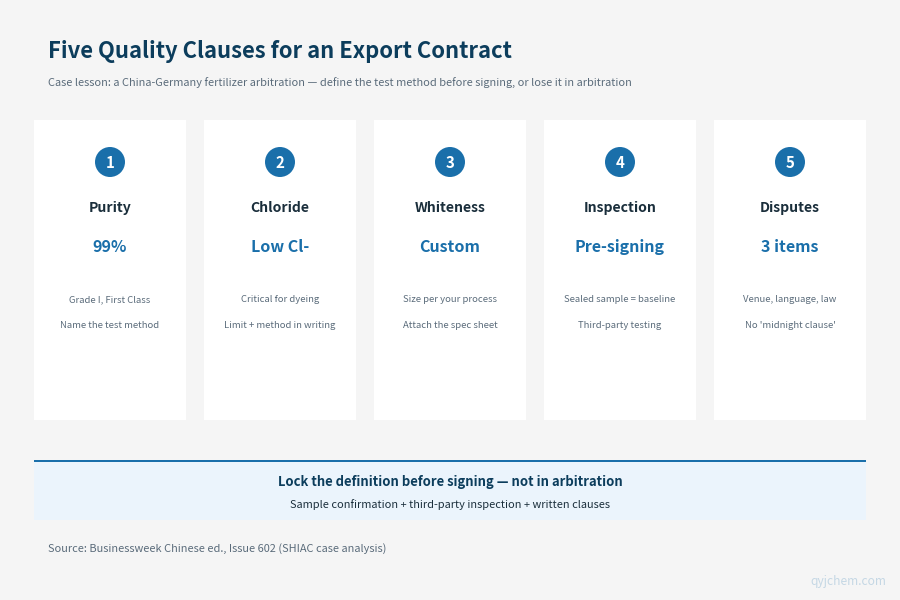
Fig. 1: Five quality clauses that must be written into a sodium sulphate export contract. Source: QINGYIJIANG Sodium Sulphate
Locking "Conformity" Before Signing: Samples and Third-party Inspection
Contract clauses decide who adjudicates after a dispute; samples and third-party inspection prevent the dispute from happening at all.
Test the sample first. QINGYIJIANG provides free samples, so buyers can run the product under their own process conditions — solubility, whiteness, particle behavior — before placing an order. A sample confirmed in writing by both sides becomes the contractual quality baseline: "conformity" turns from an abstract standard into a physical object that both parties hold.
Then bring in third-party inspection. In international arbitration, an independent third-party test report carries far more weight than either party's own testing. QINGYIJIANG supports third-party quality inspection, and export deliveries can follow the buyer's designated inspection agency. The lesson of the fertilizer case is clear: had the contract named a mutually recognized test method and third-party agency in advance, the "pure water versus saline" dispute would never have grown into an arbitration.
On trade terms, QINGYIJIANG supports FOB, CIF and DAP, shipping from any Chinese seaport, with an effective monthly supply of 65,000 tonnes. Packaging covers 25KG / 50KG / 1000KG / 1200KG woven bags, with customized branding available. Delivery terms like these should likewise be itemized in the contract.
The Dispute Resolution Clause: Don't Copy-Paste at Midnight
Beyond testing clauses, the dispute resolution clause is another common failure point. Li Tingwei notes that it is often called the "midnight clause" — negotiated at the very end of a long day of talks and copied in hastily, planting hidden risks. He recommends starting from the standard model clauses published by arbitration institutions and then customizing them for the exporter's own pattern, so that the party holds the initiative on the key elements: the seat of arbitration, the language of arbitration, and the governing law.
For long-term supply contracts of bulk chemicals such as sodium sulphate, three things must be explicit: the arbitration institution and seat, the arbitration language, and the governing law of the contract. Li also proposes a "home-ground dispute resolution" strategy — even disputes between foreign entities can be contractually referred to a trusted Chinese arbitration institution. Two Indonesian companies, for example, agreed to have their power-plant contract dispute handled by SHIAC. For exporters, keeping the dispute resolution venue in a familiar jurisdiction is itself a form of risk control.
Conclusion
Most quality disputes in chemical exports arise not because the product fails, but because "conformity" was never defined. Writing the test method, the acceptance standard and third-party inspection into the contract — and confirming the sample before signing — costs almost nothing, yet removes the largest single uncertainty in cross-border chemical trade.
QINGYIJIANG provides free samples and supports third-party quality inspection, exporting to more than 30 countries and regions and serving multinational brands including Unilever, P&G and Henkel.
For free sodium sulphate samples, third-party quality inspection reports, or advice on drafting quality clauses in export contracts, you are welcome to submit an inquiry.
Submit an Inquiry →