
Global Sodium Sulphate Reserves: A Procurement Variable Most Buyers Miss
QYJSSA/April 30,2026
Highlights
| 01 | China dominates global sodium sulphate supply; Sichuan ranks #1 nationally. Global economically recoverable reserves total ~3.3 billion tonnes. China's mirabilite resources reach ~30 billion tonnes — roughly 90% of global resources. Within China, Sichuan accounts for ~46% of national reserves, with ore grades significantly above the national average. |
| 02 | Ore grade directly drives batch consistency — a supply chain variable most buyers underestimate. Higher Na2SO4 content in raw ore means simpler purification and smaller batch-to-batch variation. Sichuan's glauberite averages 34.74% vs. the national mean of 24.24%. For textile dyeing, glass manufacturing, and detergent formulation, batch consistency affects yield rates more than unit price. |
| 03 | Origin resource conditions are a baseline criterion in supplier evaluation, not optional. Mine reserves determine long-term supply reliability; ore grade determines production stability. Request geological survey reports or third-party certified documentation to verify grade and reserve data. |
When sourcing anhydrous sodium sulphate (also known as salt cake), most procurement teams acknowledge that origin matters — but struggle to articulate exactly why. This article uses verified reserve and ore grade data to trace the chain from global resource distribution down to mine level, clarifying how origin conditions translate into real supplier capability and where they belong in your evaluation framework.
Global Sodium Sulphate Reserves: A Procurement Variable Most Buyers Miss
Natural sodium sulphate (mirabilite / glauberite) global economically recoverable reserves stand at approximately 3.3 billion tonnes. China's total mirabilite resources reach around 30 billion tonnes — roughly 90% of the global figure. The gap reflects two different measurement standards — recoverable reserves vs. total identified resources — but both numbers point to the same conclusion: China holds structural dominance over the natural sodium sulphate supply chain.
For international procurement, this means the resource-side risk of the global anhydrous sodium sulphate supply chain is effectively concentrated within China. Origin resource conditions are not supplementary supplier background information — they are a foundational dimension for assessing long-term supply reliability.
Resource Gradients Within China: Why Sichuan Leads
China's sodium sulphate reserves are not evenly distributed. Four provinces each hold over 1 billion tonnes: Sichuan, Hunan, Qinghai, and Inner Mongolia. Together they account for the overwhelming majority of national reserves — with Sichuan at approximately 46%, ranking first.
| Origin | Ore Type | Avg. Na2SO4 Grade | Reserve Scale |
|---|---|---|---|
| Sichuan | Glauberite | 34.74% | National #1 (~46%) |
| Qinghai | Natural brine / mirabilite | Varies; seasonal fluctuation | Large, subject to lake levels |
| Inner Mongolia | Natural mirabilite | Near national avg. 24.24% | Considerable, dispersed |
| National Average | — | 24.24% | — |
Sichuan's advantage is not only in reserve volume but in ore grade: 34.74% vs. a national mean of 24.24% — a gap of roughly 10 percentage points. In production, this difference has far greater practical impact than the numbers alone suggest.
How Ore Grade Affects Your Procurement Outcomes
The influence of raw ore Na2SO4 content on final product quality passes through three linked stages:
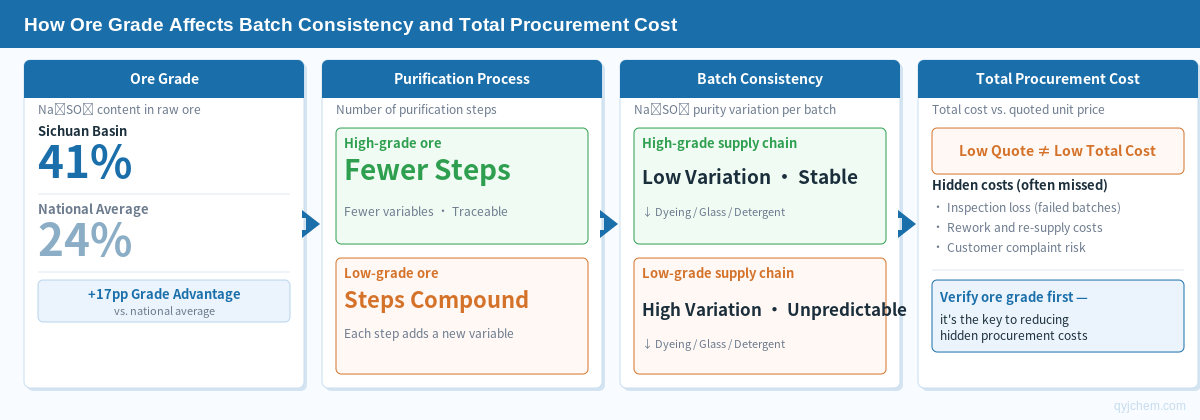
Fig. 1: How ore grade drives purification complexity, batch consistency, and total procurement cost. Source: Qingyi River Chemical Co., Ltd.
Ore grade → Purification complexity: Higher-grade ore contains fewer impurities. Lower-grade ore requires more evaporation, crystallisation, and separation steps — and each additional step introduces another potential source of batch variation.
Purification complexity → Batch consistency: Process complexity directly determines how stable product quality is from batch to batch. Na2SO4 purity variation affects dye uptake and colour difference in textile dyeing, melt temperature and bubble control in glass manufacturing, and formulation stability in synthetic detergent production.
Batch consistency → Your actual procurement cost: Inconsistent raw material generates hidden costs downstream — yield loss, rework, and customer complaint risk. These costs are dispersed across the production process and routinely underestimated at the time of purchasing, creating the classic trap of choosing a supplier whose quoted price is low but whose total cost of ownership is high.
Ore grade data should therefore be treated as a verifiable baseline parameter in supplier evaluation. Request geological survey reports, mine permits, and raw ore grade test records from accredited third-party laboratories.
Four-Level Supplier Evaluation Framework
Building on the resource logic above, a complete evaluation of anhydrous sodium sulphate suppliers can be structured across four levels:
| Resource level: Proven mine reserves (supply longevity); raw ore Na2SO4 grade (verifiable via geological survey reports); mining method (underground dynamic solution mining vs. open-pit — the former produces significantly lower environmental disruption) |
| Production level: Annual capacity vs. actual historical output; production technology (MVR energy-efficient evaporation represents current best practice); carbon emissions and energy consumption data (directly relevant for ESG sourcing compliance) |
| Compliance level: Independent third-party audit certifications (e.g. CORE Responsible Mining Certification), covering governance, labour, safety, environment, and community; product standards (e.g. GB/T 6009) and third-party test reports |
| Delivery level: Logistics network and warehousing footprint; supported trade terms (FOB / CIF / DAP); target markets served and reference customer list |
Reference Case: QINGYIJIANG® — Baita Mine, Hongya, Sichuan
QINGYIJIANG Sodium Sulphate Co., Ltd. (QYJSSA), operating the Baita Mine in Hongya County, Meishan, sits at the centre of the world's richest glauberite deposit zone. The data below benchmarks the evaluation framework above:
| Evaluation Level | Baita Mine / QYJSSA Data |
|---|---|
| Resource | Proven reserves: 25 billion tonnes; sustainable mining life: 400+ years; Na2SO4 grade ≥40% (above Sichuan avg. 34.74% and national avg. 24.24%); underground dynamic solution mining; production zone: 4.1589 km² |
| Production | Annual capacity: 1 million tonnes; 2 MVR energy-efficient evaporation lines; near-zero CO2 emissions — among the first in the domestic sector to achieve this |
| Compliance | CORE Responsible Mining Certification (2016, led by Unilever); certified by Control Union (Hong Kong); covers governance, labour, safety, environment, and community; certified annual volume: 500,000 tonnes |
| Delivery | Road, rail, and waterway access; Yangtze River Golden Waterway, China-Europe Railway Express, New International Land-Sea Trade Corridor; overseas warehouse nodes across Southeast Asia, South Asia, Middle East, Europe, and the Americas; active in 30+ countries |
Reference customers (partial): Unilever, P&G, Henkel, UNIQLO, Golden Agri-Resources (ZAPP).
To evaluate QINGYIJIANG® as your sodium sulphate supplier, request mine geological documentation, CORE certification records, product test reports, or a quotation.
Submit an Inquiry →