
Behind CATL's 60 GWh Sodium-Ion Battery Order: What Role Does Sodium Sulfate Play? (Part 2)
QYJSSA/July 24,2026
Highlights
| 01 | In aqueous sodium-ion batteries, the electrolyte itself is a sodium-salt solution in water — and sodium sulfate is one of the most widely used salts. On this route, sodium sulfate enters the cell directly as the electrolyte |
| 02 | Both American aqueous pioneers have exited: Aquion Energy filed for Chapter 11 in 2017, and Natron Energy shut down in September 2025. The IEA reports that over 95% of installed and announced sodium-ion capacity is in China — and the commercial leader in aqueous sodium-salt batteries is now a Chinese company |
| 03 | Aqueous electrolytes and sodium iron sulfate (NFS) cathodes demand far tighter chloride control and batch consistency than industrial-grade procurement; the low-chloride background and predictability of mineral-sourced sodium sulfate are the substantive entry ticket to this supply chain |
Part 1 established a fact: mainstream mass-produced sodium-ion batteries (CATL, HiNa Battery) use organic electrolytes, so Na2SO4 is not the electrolyte — it participates further upstream, as the sodium source for cathode synthesis. This article covers the other route: aqueous sodium-ion batteries, in which a sodium sulfate solution is the electrolyte itself. It also offers an honest calibration of how far this route has actually commercialized, and where it sits in the energy-storage landscape.
Aqueous Sodium-Ion Batteries: The Electrolyte Itself Is a Sodium Sulfate Solution
Aqueous sodium-ion batteries work on the same rocking-chair principle as organic systems — sodium ions shuttle between the cathode and anode. The difference lies in the transport medium: instead of NaPF6 dissolved in organic carbonate solvents, the aqueous route dissolves sodium salts directly in water, and sodium sulfate solution is among the most widely used formulations in both research and early commercial products.
Water's electrochemical stability window is theoretically only 1.23 V; beyond that, water electrolyzes. This caps the voltage and energy density of aqueous cells well below organic systems, ruling out applications such as passenger EVs. What buyers get in return is equally clear: a non-flammable, non-toxic electrolyte with no thermal runaway under nail penetration or overcharge — what the industry calls "intrinsic safety." For stationary niches where safety comes first and energy density is secondary — substation DC panels, data-center UPS, 5G base-station backup, home storage — that trade is worthwhile.
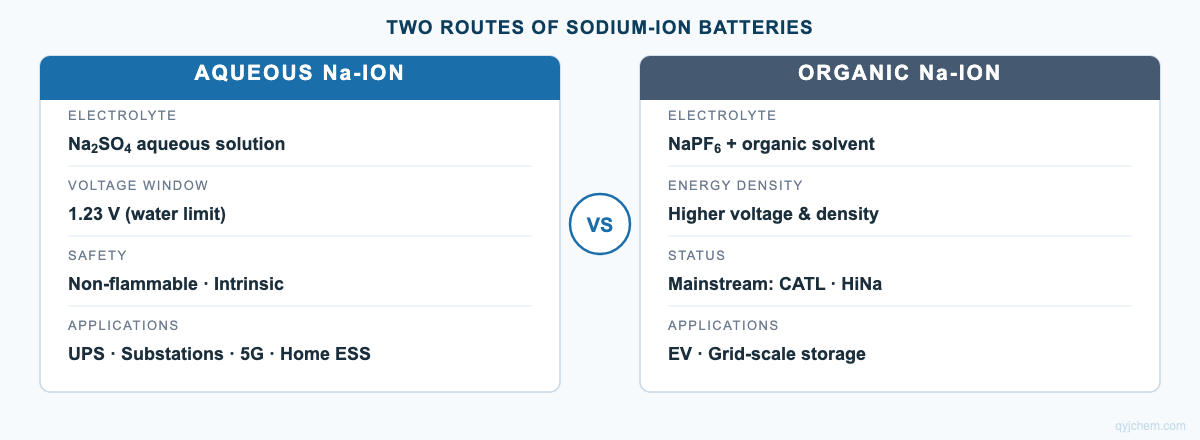
Fig. 1: Structural comparison of aqueous and organic sodium-ion battery systems (Image: qyjchem.com, Ltd.)
The first company to commercialize this route was US-based Aquion Energy, a 2008 Carnegie Mellon spinoff backed by Bill Gates, whose "saltwater battery" entered production in 2014 and was deployed in MW-scale projects worldwide (source: Sandia National Laboratories, Energy Storage Handbook).
Commercial Reality Check: US Pioneers Exit, China Takes the Lead
The commercialization history of the aqueous route deserves an honest account, because it directly shapes how mature buyers should judge this supply chain to be.
Aquion Energy filed for Chapter 11 in March 2017 and laid off over 80% of its staff; its patents and equipment were auctioned later that year to an affiliate of China Titans Energy for US$9.8 million. The second pioneer, Natron Energy, paired Prussian blue electrodes with an aqueous sodium electrolyte for the data-center UPS market, raised over US$363 million, and in 2024 announced a US$1.4 billion, 24 GWh gigafactory in North Carolina. In September 2025, Natron shut down after financing fell through, leaving roughly US$25 million in booked orders undelivered (sources: US WARN Act filings; Manufacturing Dive).
In a February 2026 commentary, the IEA cited Natron's shutdown as emblematic of how difficult it is to build sodium-ion supply chains outside China: virtually all current sodium-ion manufacturing capacity is located in China, and including announced plants, China will still account for over 95% of 2030 capacity (source: IEA, "Sodium-ion battery momentum grows, but challenges remain", 2026-02).
The aqueous route did not disappear with the American pioneers. Today's commercial leader in aqueous sodium-salt batteries is China's Ben'an Energy: its products are UL 1973 certified, with over 15 MWh of cumulative sales and more than a thousand PV-plus-storage systems operating in Europe; in cooperation with Fuji Electric, it won an overseas utility's high-safety battery projects covering hundreds of substations (sources: CNESA; Shanghai Metals Market).
The conclusion is clear: aqueous sodium-ion batteries are real, with stable niche demand — but the scale is far smaller than the mainstream organic route. For sodium sulfate suppliers, this is a high-quality niche market, not the next 10,000-tonne volume opportunity.
Another Direct Route Into the Cell: Sodium Iron Sulfate (NFS) Cathodes
"Sodium sulfate entering the battery directly" is not limited to aqueous electrolytes. Inside the mainstream organic system, sodium iron sulfate (Na2Fe(SO4)2 family, abbreviated NFS) — a polyanion cathode material — uses sodium sulfate as a direct raw material in its synthesis.
A January 2026 review by a Tianjin University team lays out the case: the strong inductive effect of sulfate groups pushes the NFS working voltage above 3 V, and the material can be synthesized at low temperatures, significantly reducing process energy consumption. Chinese companies such as Na Innovation Energy already apply wet-process NFS cathodes in solutions rated for 5,000 cycles, and industrial project filings have appeared for "10,000 t/yr NFS cathode material paired with 100,000 t/yr sodium sulfate utilization." Even beyond the aqueous route, sodium sulfate is entering cell manufacturing directly as a cathode raw material.
What Do "Electrolyte-Grade" and "Material-Grade" Actually Demand?
Entering the cell directly changes the impurity-management logic entirely: industrial-grade procurement looks at assay and price, while electrochemical applications look at the batch-to-batch consistency of trace impurities. In an aqueous electrolyte, which circulates for the cell's entire service life, chloride ions continuously corrode current collectors and drive side reactions — the effect does not appear in a single incoming inspection, but in the capacity-fade curve after thousands of cycles. The same applies to NFS synthesis, where raw-material impurities directly disturb product stoichiometry and crystal structure. What these applications demand is not "this batch passes," but "a hundred consecutive batches within the same narrow window."
This is where mineral-sourced and byproduct sodium sulfate diverge. Ore at the Baita mine of Sichuan Hongya Qingyi River Sodium Sulphate Co., Ltd. (QYJSSA) contains about 40% Na2SO4 — well above China's national average of 24.24% — with a low and predictable chloride background; a dedicated dechlorination process further narrows the Cl− range of its high-purity sodium sulfate. In late 2025, China's highest-level annual sodium sulfate industry conference designated high-purity sodium sulfate as a strategic raw material for the energy-storage materials track — "low chloride, stable, traceable" is moving from a bonus to a baseline requirement.
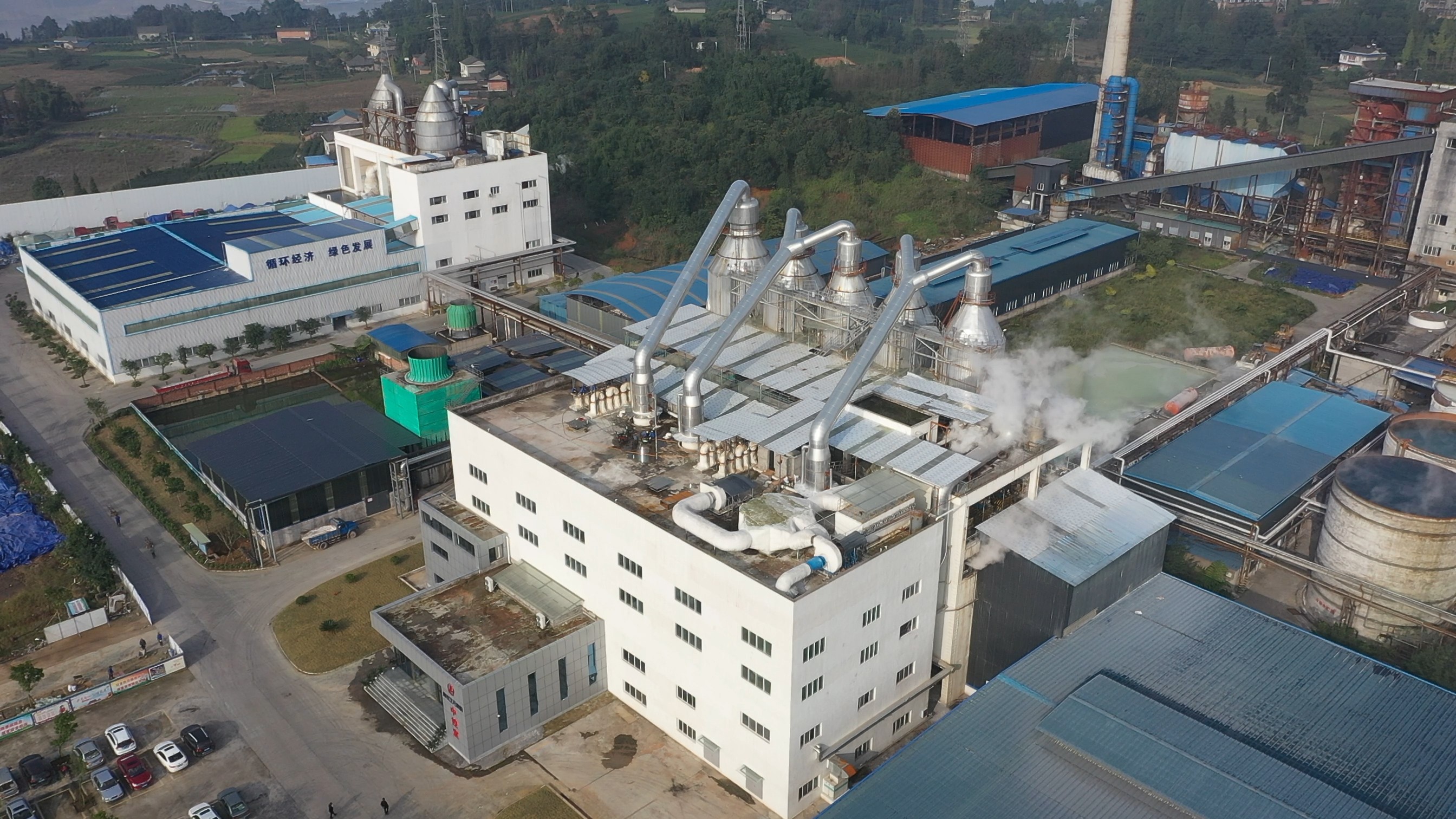
Fig. 2: Aerial view of the Qingyi River plant in Meishan, Sichuan (Image:Qingyi River Sodium Sulphate Co, Ltd.)
To learn more about the technical specifications of our high-purity sodium sulfate for electrolyte-grade applications, request continuous batch-testing reports, or order product samples, please get in touch via our website's contact page.
Submit an Inquiry →